Coil Biofilm and AC Efficiency Loss Explained Dubai
Coil Biofilm and AC Efficiency Loss Explained begins with something invisible. Your air conditioning system appears to be running. Cool air is moving through the vents. The unit powers on and off as expected. But somewhere between those observations and actual comfort, something is wrong — the air feels heavier than it should, the system runs longer than it used to, and your electricity consumption has quietly increased. In most Dubai homes investigated by Saniservice specialists, the cause traces back to one underdiagnosed condition: biofilm accumulation on the evaporator and condenser coils.
Coil biofilm is not visible grime. It is a structured microbial layer — bacteria, fungi, organic matter, and mineral deposits bonded together by a protective matrix — that adheres to coil surfaces and resists routine cleaning. In Dubai’s climate, where AC systems operate continuously through temperatures exceeding 45°C and humidity levels that climb significantly during summer months, coil surfaces remain perpetually damp. That moisture, combined with airborne dust and organic particulates, creates conditions where biofilm establishes and thickens steadily between service visits. This relates directly to Coil Biofilm and AC Efficiency Loss.
Understanding Coil Biofilm and AC Efficiency Loss Explained properly means understanding that this is not a maintenance failure — it is a physics problem. Biofilm does not simply sit on a coil. It actively insulates it. And when the coil cannot transfer heat efficiently, the entire refrigeration cycle suffers. The result is measurable: longer run cycles, reduced cooling output, elevated compressor strain, and energy consumption that climbs without any visible explanation.
Coil Biofilm and AC Efficiency Loss: What Coil Biofilm Actually Is
Contents
- 1 Coil Biofilm and AC Efficiency Loss: What Coil Biofilm Actually Is
- 2 How Biofilm Forms on Dubai AC Coils
- 3 The Efficiency Loss Mechanism
- 4 Recognising Coil Biofilm Without Opening the System
- 5 Professional Coil Cleaning as the Solution
- 6 Coil Biofilm and AC Efficiency Loss Explained — Prevention and Maintenance Intervals
- 7 Coil Biofilm and AC Efficiency Loss Explained — Key Takeaways for Dubai Homeowners
- 8 Frequently Asked Questions
- 8.1 What is coil biofilm and why does it affect AC efficiency?
- 8.2 How does Dubai’s climate make coil biofilm worse than in other regions?
- 8.3 Can I identify coil biofilm without opening the AC unit?
- 8.4 Why does rinsing the coil with water not remove biofilm?
- 8.5 How often should AC coils be professionally cleaned in Dubai villas?
- 8.6 Is the disinfection applied to coils safe for families and children?
- 8.7 Does coil biofilm also affect the condenser coil outside the villa?
Biofilm is a term borrowed from microbiology, but its consequences in HVAC systems are entirely mechanical as well as biological. When micro-organisms — primarily bacteria and mould species — land on a moist surface, they do not remain as individual cells. They secrete a polysaccharide matrix that anchors them to the substrate, shields them from environmental stress, and progressively recruits additional organic material from the airstream passing through the coil.
On an evaporator coil, this matrix grows between the aluminium fins and along the copper tubing. It is typically grey, brown, or greenish in tone, with a slightly gelatinous or slick texture when disturbed. In laboratory analysis of samples collected from Dubai residential systems, this material commonly contains mixed microbial populations including heat-tolerant bacterial species and mould genera adapted to high-humidity, low-light conditions. When considering Coil Biofilm and AC Efficiency Loss, this becomes clear.
The critical distinction between ordinary dust on a coil and true biofilm is structural integrity. Dust can be dislodged by airflow or a basic rinse. Biofilm cannot. Its matrix binds it firmly to metal surfaces, meaning that water spray alone — the method used by many general maintenance contractors — disperses the outer layer while leaving the adherent core untouched. Coil Biofilm and AC Efficiency Loss Explained correctly must account for this structural resistance, because it determines which cleaning methods actually work.
How Biofilm Forms on Dubai AC Coils
Continuous Operation Creates Persistent Moisture
In temperate climates, AC systems cycle on and off across seasons, allowing coil surfaces to dry completely between uses. In Dubai, residential systems in many homes run eight to twenty hours per day throughout the year. Evaporator coils rarely reach a sustained dry state. Condensation forms continuously during operation and the drainage cycle only partially removes surface moisture. That residual dampness is the foundation biofilm requires. The importance of Coil Biofilm and AC Efficiency Loss is evident here.
Dust Infiltration Provides Organic Substrate
Dubai’s air carries fine particulate matter from desert dust, construction activity, and vehicular emissions. Even with filters in place, ultra-fine particles pass through standard residential filters and reach coil surfaces. These particles carry organic material — skin cells, pollen fragments, fungal spores, and bacterial cells — that the biofilm matrix incorporates as it develops. In villas near construction zones or in properties with ageing filter housings, particulate loading on coils is commonly observed to be substantially higher than in well-sealed properties.
High Humidity Accelerates Microbial Activity
During the summer months across Dubai, Abu Dhabi, and the coastal areas of Sharjah and Ajman, outdoor relative humidity frequently exceeds 80%. Even in air-conditioned interiors, the moisture burden on evaporator coils increases. Mould species thrive in relative humidity above 60%, and the coil bay — where condensation is constant and airflow is restricted — consistently exceeds that threshold. Coil Biofilm and AC Efficiency Loss Explained in the Gulf context must recognise humidity as a primary accelerant, not a secondary factor.
The Efficiency Loss Mechanism
Heat transfer is the central function of an HVAC coil. The evaporator coil absorbs heat from indoor air; the condenser coil releases it outdoors. Both processes depend on direct thermal contact between refrigerant-carrying tubing and the air passing across the coil surface. Biofilm disrupts this contact at the most critical point: the metal surface itself.
Even a thin biofilm layer — measured in fractions of a millimetre — introduces meaningful thermal resistance. The microbial matrix and its organic content conduct heat far less effectively than clean aluminium or copper. As biofilm thickens, the coil’s ability to exchange heat with the passing airstream diminishes progressively. The refrigeration system responds by running longer compressor cycles in an attempt to reach the target temperature. That extended runtime translates directly into higher energy consumption per cooling cycle. Understanding Coil Biofilm and AC Efficiency Loss helps with this aspect.
Field investigations by Saniservice technicians in Dubai villas commonly identify coils where biofilm accumulation has become significant enough to cause measurable reduction in cooling output — observed as temperature differentials across the coil that fall short of design specification. This is Coil Biofilm and AC Efficiency Loss Explained in practical terms: the system works harder, costs more to operate, and delivers less.
Compressor Strain and Long-Term Damage
The compressor is the most mechanically stressed component in any AC system. When biofilm on the evaporator coil reduces heat absorption, refrigerant returning to the compressor carries more heat than the system was designed to handle. This elevated suction temperature increases compressor operating pressure and temperature, accelerating wear on components that are already under significant stress in Dubai’s ambient conditions. Coil Biofilm and AC Efficiency Loss Explained at the system level must include this downstream consequence — what begins as a surface contamination issue can progress to compressor degradation if left unaddressed.
Recognising Coil Biofilm Without Opening the System
Most homeowners do not have access to the coil bay during normal operation, but several observable indicators suggest biofilm-driven efficiency loss. The first is duration of run cycles: if the system runs noticeably longer to achieve the same set temperature compared to previous seasons, reduced coil performance is a primary suspect. The second is odour — biofilm produces volatile organic compounds as metabolic by-products, and a sour, musty, or earthy smell from the air discharge vents is a consistent field indicator of active microbial accumulation on coil surfaces.
The third indicator is electricity consumption. In Dubai homes with relatively stable occupancy and usage patterns, a gradual but unexplained increase in monthly consumption — without a change in thermostat setting — frequently corresponds to degraded coil efficiency. Coil Biofilm and AC Efficiency Loss Explained as a diagnostic framework means connecting these indirect signals to the underlying mechanical cause before more expensive symptoms appear.
Professional Coil Cleaning as the Solution
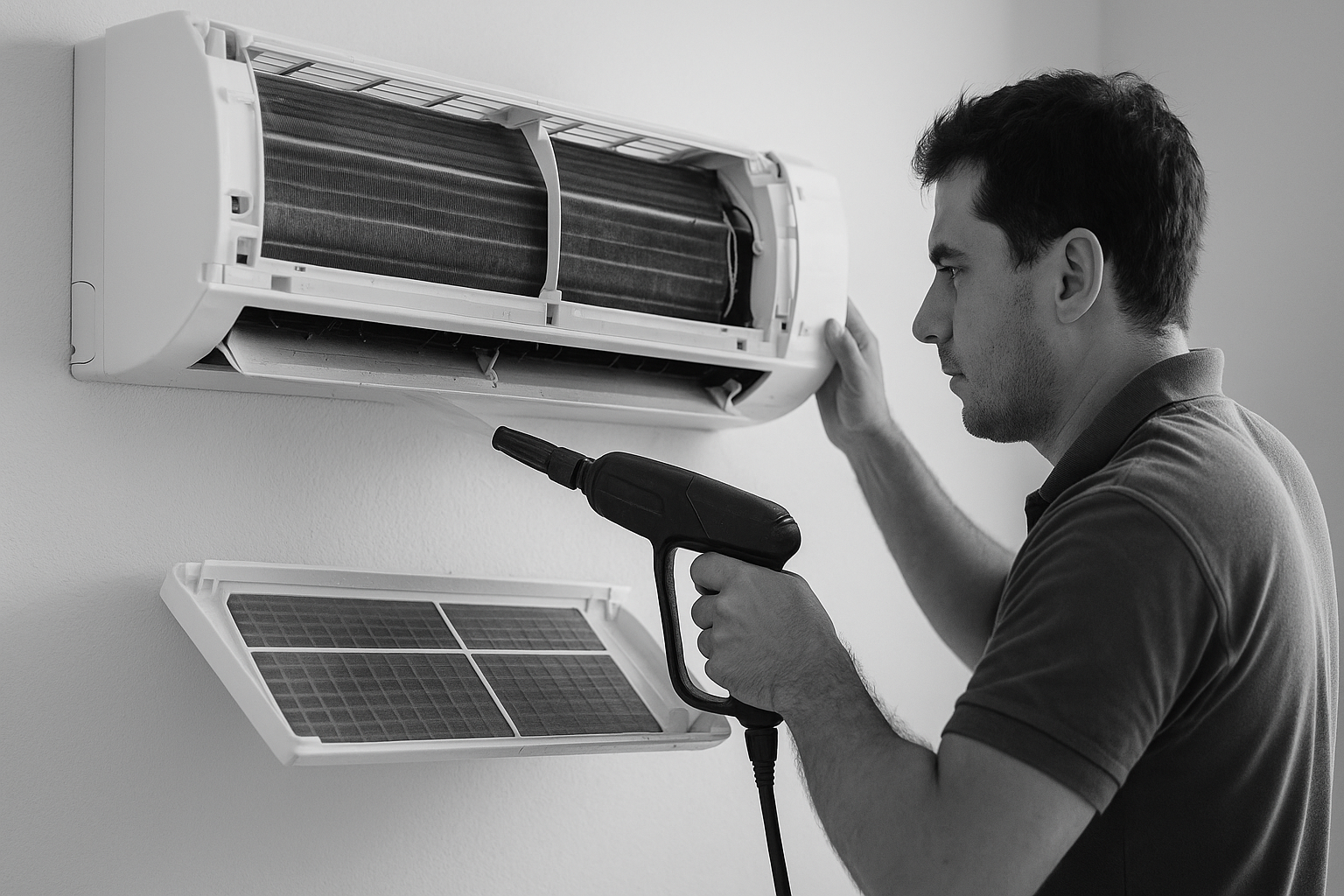
Resolving biofilm-related efficiency loss requires more than spraying the coil with water or applying a general-purpose cleaner. The biofilm matrix is chemically resistant to weak solutions and physically resistant to low-pressure rinsing. Effective remediation follows a documented protocol that Saniservice technicians apply across Dubai residential and commercial systems.
Alkaline Pre-Treatment for Biofilm Disruption
The first step is application of an alkaline coil cleaner formulated to penetrate and disrupt the biofilm matrix. Alkaline chemistry breaks the polysaccharide bonds that anchor biofilm to the metal substrate. The solution is applied at appropriate concentration and allowed a timed dwell period — this contact time is essential and is frequently skipped by contractors prioritising speed over results. Rushing this stage leaves the adherent biofilm layer intact beneath a partially dissolved surface. Coil Biofilm and AC Efficiency Loss factors into this consideration.
Controlled Rinse and Drain Inspection
Following dwell time, the coil is rinsed with controlled-pressure water to remove loosened material. The condensate drain pan and drain line are inspected simultaneously, as biofilm debris flushed from the coil commonly accumulates in the drain tray and can cause blockage if not cleared. Drain pan biofilm — a separate accumulation that develops in the standing water beneath the coil — is addressed at this stage as well.
Swiss Bio-Sanitiser Application
After mechanical removal of biofilm, Saniservice applies a Swiss bio-sanitiser to coil surfaces and the surrounding coil bay. This product is formulated for occupied environments and is safe for use in homes where children and sensitive occupants are present. Its function is to inhibit microbial re-colonisation in the weeks following cleaning, extending the interval before biofilm can re-establish to the level that affects efficiency. This step is what separates a surface clean from a documented protocol. This relates directly to Coil Biofilm and AC Efficiency Loss.
Coil Biofilm and AC Efficiency Loss Explained — Prevention and Maintenance Intervals
Coil Biofilm and AC Efficiency Loss Explained as a preventive framework points clearly to maintenance frequency as the most practical lever available to homeowners. In Dubai’s continuous-use climate, NADCA-aligned guidance supports annual coil inspection and cleaning as a baseline for residential systems. Properties with higher particulate exposure — near construction, in older buildings with degraded filter housings, or with a history of moisture infiltration — benefit from a six-month inspection cycle.
Filter maintenance is the supporting measure that directly affects coil contamination rates. Filters that are changed or cleaned on schedule reduce the organic load reaching coil surfaces. In villa systems with return air grilles drawing from living spaces, a clean filter can meaningfully slow biofilm development between professional service visits. When considering Coil Biofilm and AC Efficiency Loss, this becomes clear.
Humidity management also plays a role. In properties where indoor relative humidity consistently exceeds 60%, a review of the AC system’s dehumidification performance and drainage design can identify conditions that accelerate microbial growth. Saniservice specialists assess these factors during property-specific inspections and provide recommendations tailored to the building’s actual conditions rather than generic schedules.
Coil Biofilm and AC Efficiency Loss Explained — Key Takeaways for Dubai Homeowners
- Biofilm on AC coils is a structured microbial layer that insulates coil surfaces and reduces heat transfer — it is not removable by standard rinse methods.
- In Dubai’s climate, continuous operation and high humidity create conditions where biofilm establishes and thickens faster than in temperate environments.
- Efficiency loss from coil biofilm presents as longer run cycles, musty odours, and increased energy consumption — all before any mechanical failure occurs.
- Effective remediation requires alkaline pre-treatment, dwell time, controlled rinse, drain pan clearance, and bio-sanitiser application as a complete documented protocol.
- Annual professional coil cleaning, supported by regular filter maintenance, is the most reliable preventive measure available to residential and commercial property occupants.
- A professional assessment determines the actual scope of contamination — contact Saniservice for a property-specific evaluation rather than assuming a standard service will address biofilm-level accumulation.
Coil Biofilm and AC Efficiency Loss Explained ultimately comes down to one principle: what you cannot see is still working against you. The coil operating behind your ceiling cassette or inside your wall unit is either transferring heat efficiently or it is not. Biofilm is the most common reason it is not — and in Dubai, where AC systems carry the full weight of indoor comfort for most of the year, that distinction has real consequences for both wellbeing and operating cost.
Frequently Asked Questions
What is coil biofilm and why does it affect AC efficiency?
Coil biofilm is a structured layer of micro-organisms, organic material, and mineral deposits that adheres to evaporator and condenser coil surfaces. It acts as thermal insulation, reducing the coil’s ability to transfer heat between the refrigerant and the airstream. This forces the AC system to run longer cycles to achieve the same cooling output, increasing energy consumption and compressor strain.
How does Dubai’s climate make coil biofilm worse than in other regions?
Dubai’s combination of near-continuous AC operation, high summer humidity, and significant airborne dust creates ideal conditions for biofilm development. Coils rarely dry out completely between cycles, providing persistent moisture for microbial colonisation. Airborne particulates from desert and construction activity supply organic substrate. These factors together mean biofilm accumulates faster in Dubai than in seasonal or lower-humidity climates. The importance of Coil Biofilm and AC Efficiency Loss is evident here.
Can I identify coil biofilm without opening the AC unit?
Several indicators suggest coil biofilm without direct inspection. A sour or musty odour from the air discharge vents is a consistent signal of active microbial accumulation. Longer run cycles to reach the set temperature, unexplained increases in electricity consumption, and reduced airflow volume are all commonly observed in systems where biofilm-driven efficiency loss has developed. A professional inspection confirms the diagnosis.
Why does rinsing the coil with water not remove biofilm?
Biofilm is anchored to the coil surface by a polysaccharide matrix that resists both water pressure and weak cleaning agents. A water rinse removes loose surface debris but leaves the adherent biofilm layer intact. Effective removal requires an alkaline pre-treatment formulated to chemically disrupt the matrix, followed by a timed dwell period before controlled rinsing — a documented protocol that differs substantially from a basic coil wash. Understanding Coil Biofilm and AC Efficiency Loss helps with this aspect.
How often should AC coils be professionally cleaned in Dubai villas?
NADCA-aligned guidance supports annual coil inspection and cleaning as a baseline for residential systems in Dubai. Properties with higher contamination exposure — near active construction, in older buildings, or with a history of moisture issues — benefit from a six-month inspection cycle. The appropriate frequency for a specific property is best determined during a site assessment rather than from a generic schedule.
Is the disinfection applied to coils safe for families and children?
Saniservice uses a Swiss bio-sanitiser formulated specifically for occupied environments. It is applied to coil surfaces and the surrounding coil bay after biofilm removal, and it is safe for homes where children, elderly residents, and occupants with respiratory sensitivities are present. Proper ventilation following application is observed as part of the documented protocol to ensure safe re-occupancy. Coil Biofilm and AC Efficiency Loss factors into this consideration.
Does coil biofilm also affect the condenser coil outside the villa?
Yes. The condenser coil — located in the outdoor unit — is exposed to Dubai’s ambient heat, dust, and occasional humidity. While it does not experience the same condensation conditions as the evaporator coil, biofilm and organic fouling do develop on condenser surfaces over time, particularly in enclosed plant rooms or areas with restricted airflow. Condenser coil contamination reduces the system’s ability to reject heat outdoors, compounding the efficiency loss caused by a fouled evaporator coil. Understanding Coil Biofilm and AC Efficiency Loss is key to success in this area.