How Dirty AC Ducts Affect Indoor Air Quality UAE Homes
How dirty AC ducts affect indoor air quality UAE residents experience is one of the most practical and consequential questions in residential and commercial health management across the Emirates. In a climate where air conditioning operates year-round — often 24 hours a day — the duct system is not simply infrastructure. It is the pathway through which every breath of recirculated indoor air passes, day after day, month after month.
Unlike temperate climates where windows are opened regularly and systems rest for months at a time, UAE buildings are sealed environments. Desert dust infiltrates constantly. Summer humidity drives condensation inside cooling systems. Construction activity across Dubai, Sharjah, and Abu Dhabi introduces fine particulate matter that travels into ductwork and settles. Over time, that accumulation builds into a contamination profile that a simple filter change cannot address. This relates directly to How Dirty AC Ducts Affect Indoor Air Quality Uae.
Understanding how dirty AC ducts affect indoor air quality UAE homes and offices is the first step towards making decisions that protect occupants — particularly children, elderly residents, and those with respiratory sensitivities. This article presents a structured comparison of clean versus contaminated duct conditions, examines what the real differences are, and helps you assess where your system currently sits.
Why UAE Ducts Contaminate Faster Than Most Climates
The UAE presents a combination of conditions that accelerates duct contamination at a rate that has no real parallel in most other countries. This is not a generalisation — it is an observation grounded in the specific physics and biology of how HVAC systems respond to this environment.
Continuous operation means duct surfaces never dry out fully. Moisture from condensation clings to duct walls, drain pans, and coil surfaces around the clock. Desert dust and fine sand particles are drawn in through building envelopes, gaps in facades, and opening doors. Humidity during the summer months — frequently above 80% in coastal areas — creates the precise moisture conditions that microbial organisms require to establish and grow.
Add to that the construction activity across major UAE cities, which introduces silica dust, drywall particulates, and chemical residues into the air supply, and you have a system that requires far more frequent attention than its equivalent in a cooler, drier, or less urbanised setting.
What Builds Up Inside Dirty AC Ducts
When discussing how dirty AC ducts affect indoor air quality UAE buildings experience, it is important to be specific about what contamination actually consists of. The interior of a neglected duct system is rarely just dusty. It is a layered accumulation of distinct materials, each with different health and performance implications.
Dust and Particulate Matter
Fine desert dust, construction particulates, skin cells, textile fibres, and general household debris settle onto duct walls and accumulate in corners and horizontal runs. When the system operates, airflow disturbs this layer and reintroduces particles directly into breathing air. In UAE apartments and villas, this cycle repeats hundreds of times daily.
Microbial Growth — Mould, Bacteria, and Biofilm
Moisture inside continuously operating systems creates a habitat for mould spores and bacteria. Biofilm — a structured community of microorganisms embedded in a protective matrix — forms along drain lines, on drain pans, and on coil surfaces. Once established, biofilm is not removed by standard cleaning alone. It requires targeted disinfection. Spores released from biofilm colonies travel through duct systems and deposit throughout the indoor environment.
Allergens and Biological Material
Dust mite debris, pet dander, and pollen accumulate within duct deposits. These biological allergens are particularly relevant in homes with children, where allergic sensitisation during early development carries long-term health implications.
How Dirty AC Ducts Affect Indoor Air Quality UAE — Clean vs Contaminated
Understanding how dirty AC ducts affect indoor air quality UAE residents experience is most clearly illustrated through direct comparison. The following structured analysis contrasts the conditions and outcomes associated with clean versus contaminated duct systems.
Clean Duct System — Conditions and Outcomes
- Airflow moves through clear pathways with minimal resistance
- Supply air contains low particulate and microbial load
- No odour is introduced into living or working spaces
- Evaporator coils maintain design-rated heat exchange efficiency
- Drain pans and drain lines remain free of biofilm obstruction
- Occupants with respiratory sensitivities report fewer triggered symptoms
- System energy consumption aligns with rated specifications
Contaminated Duct System — Conditions and Outcomes
- Dust deposits restrict airflow and increase static pressure
- Supply air carries elevated concentrations of dust, allergens, and in some cases mould spores
- Musty or stale odours are introduced consistently into indoor spaces
- Coil fouling reduces cooling capacity and increases energy draw
- Blocked drain lines cause water overflow, further increasing indoor humidity
- Allergy and asthma symptoms in occupants may worsen or become harder to manage
- Energy bills increase due to reduced system efficiency
The gap between these two states is not hypothetical. It is measurable, and in my direct experience across hundreds of residential and commercial properties in Dubai, Sharjah, and Abu Dhabi, the difference in perceived air quality is often immediate and noticeable to occupants following proper deep cleaning.
Health Consequences of Contaminated Duct Systems
How dirty AC ducts affect indoor air quality UAE families experience translates directly into health outcomes that are often attributed to other causes. Upper respiratory irritation, persistent coughing, and nasal congestion are among the most commonly reported symptoms in homes with heavily contaminated systems. These symptoms frequently improve after thorough duct cleaning and disinfection — not because the duct work is the only factor, but because it is a continuous source of re-exposure.
Mould exposure deserves particular attention. In sealed UAE buildings where contaminated air is recirculated rather than diluted with fresh outdoor air, even moderate mould spore concentrations can accumulate to levels that affect sensitive individuals. Symptoms range from mild irritation to significant respiratory distress in those with established sensitivities or compromised immune function.
Children are especially relevant here. A child sleeping in a room where the AC runs through the night is breathing recirculated air for eight or more hours without interruption. If the supplying duct carries dust, allergens, or mould spores, that exposure compounds night after night. This is not an abstract risk — it is a real and preventable situation.
How Dirty AC Ducts Affect Indoor Air Quality UAE and System Efficiency
How dirty AC ducts affect indoor air quality UAE buildings experience is not limited to biological contamination. There is a direct mechanical relationship between duct hygiene and system performance that affects both comfort and operating cost.
When dust accumulates on evaporator coils — which happens as contaminated air passes across their surface — the insulating layer of debris reduces the coil’s ability to transfer heat. The system must run longer to achieve the same cooling effect. In practical terms, a fouled coil can increase energy consumption by 10 to 25 percent. Across a Dubai summer where cooling runs continuously for five to six months, that represents a meaningful increase in electricity expenditure.
Restricted airflow from duct deposits creates similar inefficiency at a system level. The fan works against increased resistance, drawing more power. Supply air reaches rooms at reduced velocity, leading to uneven cooling and occupant discomfort. These are the conditions that prompt residents to lower the thermostat further — compounding both the energy cost and the humidity problem.
Duct Cleaning vs Filter Replacement — What Each Actually Addresses
A common and understandable misconception is that regular filter replacement addresses duct contamination. This is worth examining directly, because it shapes how UAE residents manage their systems and what outcomes they should reasonably expect.
What Filter Replacement Achieves
A clean filter captures incoming particulates before they enter the duct system. This is genuinely important, and a blocked or bypassed filter allows accelerated contamination of the entire system downstream. However, filter replacement addresses only what is entering the system going forward. It does not remove what has already accumulated inside ducts, on coils, in drain pans, or within the duct lining material itself.
What Professional Duct Cleaning Achieves
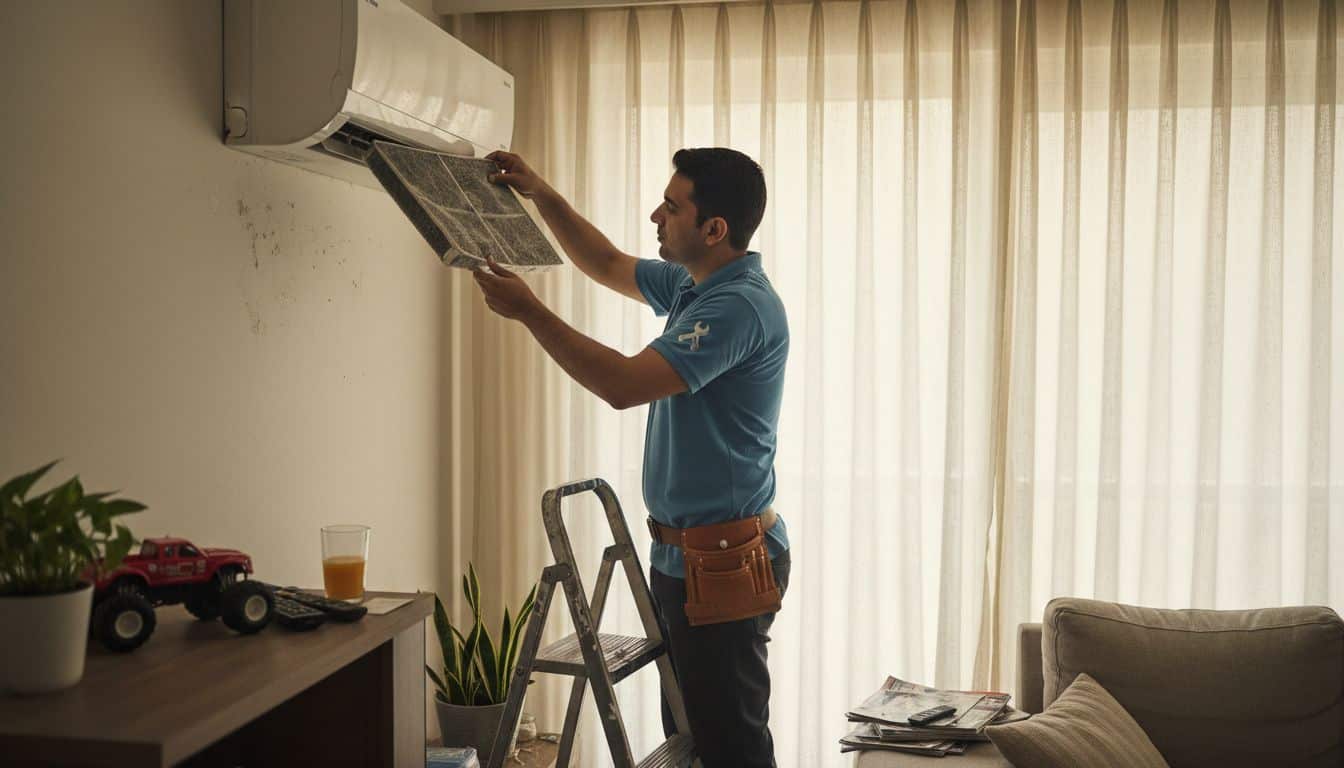
Professional duct cleaning, performed with appropriate equipment — including HEPA-filtered negative pressure containment, mechanical agitation, and targeted disinfection — removes existing deposits from duct surfaces, coils, and drainage components. It addresses the contamination that has already built up, rather than preventing only future accumulation.
Both are necessary. Filter replacement maintains a clean system. Professional cleaning restores a contaminated one. Using filter replacement as a substitute for duct cleaning in a system that has been operating for two or more years in UAE conditions is like wiping a kitchen bench while leaving the interior of the oven uncleaned. The visible surface improves; the source of contamination remains.
How Dirty AC Ducts Affect Indoor Air Quality UAE for Vulnerable Occupants
How dirty AC ducts affect indoor air quality UAE environments create for vulnerable populations deserves specific consideration. Across clinics, nurseries, schools, and homes with elderly residents or immunocompromised individuals, contaminated duct systems represent a disproportionate risk.
In clinical settings, HVAC hygiene is addressed under regulatory frameworks that set standards for microbial load and air change rates. However, residential and commercial environments often lack this oversight, and occupants with conditions such as asthma, rhinitis, eczema, or post-surgical recovery are exposed to the same duct contamination as anyone else in the building.
For families with young children in Dubai and across the UAE, addressing how dirty AC ducts affect indoor air quality UAE homes produce is a direct act of health protection. The economic case is straightforward too — the cost of professional duct cleaning, typically ranging from AED 800 to AED 3,500 depending on system size and property type, is modest relative to the cumulative cost of medical consultations, medication, and lost productivity that poor indoor air quality can contribute to.
When Professional Duct Cleaning Is Warranted
The following conditions indicate that professional assessment or cleaning is appropriate:
- Visible dust discharge from supply diffusers when the system starts
- Persistent musty, sour, or stale odour from AC outlets
- Occupants experiencing increased allergy or respiratory symptoms without clear alternative cause
- Post-renovation or post-construction occupancy, where construction dust has entered the duct system
- More than 18 to 24 months since the last professional duct cleaning
- Visible mould growth near supply or return air grilles
- Water staining around ceiling diffusers indicating drain pan overflow
- Reduced airflow from supply vents despite a clean filter
Each of these conditions reflects a system state where how dirty AC ducts affect indoor air quality UAE occupants breathe has moved beyond a theoretical concern into an active and addressable problem.
How Dirty AC Ducts Affect Indoor Air Quality UAE — Expert Verdict
How dirty AC ducts affect indoor air quality UAE buildings produce is not a question with a complicated answer. Contamination inside duct systems — whether dust, biological growth, allergens, or debris from construction — is introduced continuously into the indoor environment whenever the system operates. In the UAE, that means effectively all day, every day, for most of the year.
The comparison between clean and contaminated systems is clear: cleaner ducts produce measurably better air quality, fewer symptoms among sensitive occupants, lower energy consumption, and a more comfortable indoor environment. There is no credible argument that allowing duct accumulation to continue in a sealed, continuously cooled building produces neutral or acceptable outcomes over time.
The responsible approach is preventive rather than reactive. Annual professional inspection and cleaning, combined with regular filter maintenance and drain line care, keeps contamination from reaching the threshold where it begins affecting occupant health. This is not an aggressive recommendation — it is the minimum standard that a continuously operating HVAC system in UAE conditions reasonably requires.
If you have concerns about how dirty AC ducts affect indoor air quality UAE homes or commercial premises under your care, begin with a professional inspection. A qualified technician can assess the actual state of your system, explain what they find, and recommend appropriate action — without exaggerating risk or recommending treatment that is not warranted. That transparency is the standard to expect, and the standard by which good AC hygiene services should be judged.