Mold Inside AC Ducts Guide
Understanding Mold Inside AC Ducts: What Dubai Residents Should Know is essential. Mold inside AC ducts in Dubai is not a rare or extreme scenario — it is a commonly observed finding during professional HVAC inspections across the emirate’s villas, apartments, and commercial spaces. Dubai’s climate creates the exact set of conditions that allow duct contamination to take hold: surfaces that never fully dry, systems that run continuously, and sealed indoor environments that recirculate air without adequate dilution. Understanding what this means for your home or office is the first step toward measurable improvement in your indoor wellbeing.
Mold inside AC ducts is a topic that residents across Dubai, Abu Dhabi, Sharjah, Ajman, and Ras Al Khaimah are increasingly asking about — and with good reason. What begins as a subtle shift in air quality often signals a deeper condition inside the ductwork itself. The good news is that with proper diagnosis and a structured cleaning methodology, the issue is entirely addressable. What matters is understanding why it happens here specifically, and what a proper response actually involves. This relates directly to Mold Inside AC Ducts: What Dubai Residents Should Know.
This article draws on field observations from over 13 years working inside Dubai’s HVAC systems to give residents a grounded, clear-eyed view of the issue — without exaggeration, and with practical guidance on what to look for, what to request from a service provider, and how to prevent recurrence. When considering Mold Inside AC Ducts: What Dubai Residents Should Know, this becomes clear.
Mold Inside AC Ducts: What Dubai Residents Should Know – Why Mold Inside AC Ducts Is a Dubai-Specific Challenge
Dubai’s climate creates a set of compounding conditions that simply do not exist in most other parts of the world. Summer temperatures regularly exceed 42°C, relative humidity climbs sharply between June and September, and air conditioning systems run continuously — often 24 hours a day, seven days a week. This uninterrupted operation means duct surfaces, coil fins, and drain components rarely experience the drying cycles that would naturally suppress microbial activity. The importance of Mold Inside AC Ducts: What Dubai Residents Should Know is evident here.
When warm, humid outdoor air infiltrates a cooled duct system — through leaking joints, improperly sealed registers, or even normal system cycling — condensation forms on metal duct surfaces and insulation linings. That moisture, combined with the fine dust particles that Dubai’s desert environment introduces continuously, creates the substrate that supports biological growth over time. Understanding Mold Inside AC Ducts: What Dubai Residents Should Know helps with this aspect.
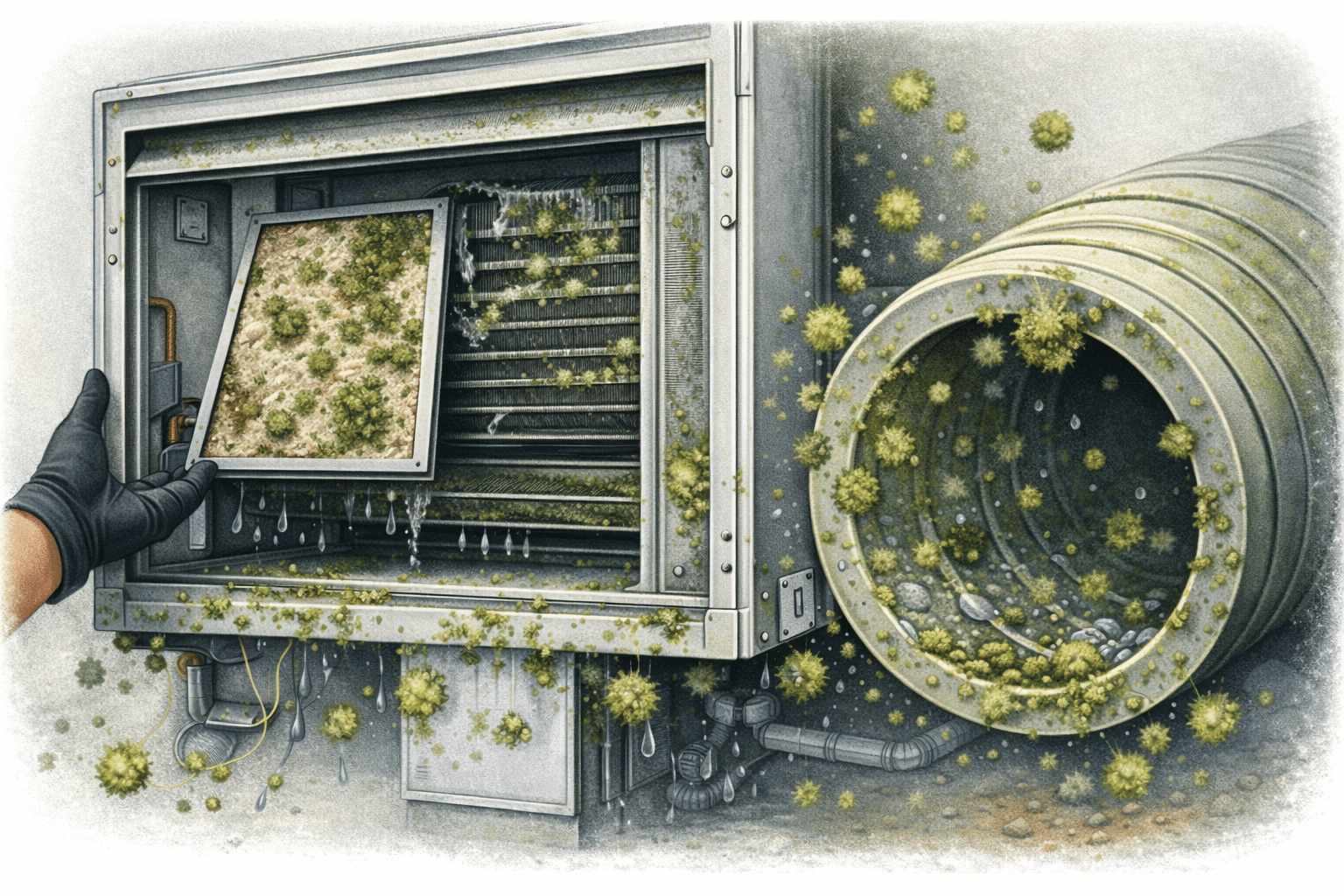
Field investigations across Dubai villas and high-rise apartments consistently show that mold inside AC ducts tends to concentrate near the evaporator coil housing, along drain pan surfaces, inside flexible duct sections with accumulated dust, and around supply registers that experience frequent temperature differentials. These are the zones where moisture and particle matter converge most reliably. Mold Inside AC Ducts: What Dubai Residents Should Know factors into this consideration.
Mold Inside AC Ducts: What Dubai Residents Should Know – How to Recognise Mold Inside AC Ducts in Your Home
The early indicators of mold inside AC ducts are often sensory rather than visual, because the contamination typically develops in zones that residents cannot see. Knowing what to pay attention to makes early identification significantly more reliable. This relates directly to Mold Inside AC Ducts: What Dubai Residents Should Know.
Odour Changes That Signal Duct Contamination
A musty or earthy smell that appears when the AC first starts, or that lingers faintly throughout the day, is the most consistent indicator field specialists encounter. The odour often intensifies in enclosed rooms with low airflow — bedrooms and nurseries are the most commonly reported locations in Dubai villas. If the smell disappears when windows are opened but returns when the AC runs, that pattern is worth investigating professionally. When considering Mold Inside AC Ducts: What Dubai Residents Should Know, this becomes clear.
Physical and Surface Indicators
Dark spotting around supply registers, a visible residue on diffuser blades, or discolouration on the ceiling surrounding vent openings can all point toward duct contamination. In some cases, residents notice that the same register requires repeated cleaning within very short intervals — a clear sign that something inside the ductwork is contributing to surface recontamination. The importance of Mold Inside AC Ducts: What Dubai Residents Should Know is evident here.
Occupant Comfort and Wellbeing Changes
Residents sometimes report that certain rooms feel heavier or stuffier than others despite the thermostat being consistent. Others notice that mornings feel clearer than evenings in air-conditioned rooms, or that they breathe more comfortably when spending time outdoors. These are subjective observations, but they are worth noting as context for a professional indoor air quality assessment. Understanding Mold Inside AC Ducts: What Dubai Residents Should Know helps with this aspect.
Mold Inside AC Ducts: What Dubai Residents Should Know – What Dubai Residents Should Know About Duct Contamination Pa
Mold inside AC ducts does not develop randomly. It follows specific pathways that are predictable once you understand the system. For Dubai residents evaluating whether their system needs professional attention, understanding contamination pathways helps frame the right questions to ask a service provider. Mold Inside AC Ducts: What Dubai Residents Should Know factors into this consideration.
The evaporator coil is almost always the origin point. When a coil becomes coated with biological film — a biofilm layer that forms progressively in humid conditions — it loses heat exchange efficiency and becomes a continuous source of contamination for everything downstream. Air passing over a biofilm-coated coil picks up particulate and biological matter and distributes it through every metre of ductwork connected to that system. This relates directly to Mold Inside AC Ducts: What Dubai Residents Should Know.
The condensate drain pan compounds this further. In a properly functioning system, the drain pan removes moisture efficiently. In systems that have not been serviced to a full-depth standard, the drain pan accumulates biological matter, the drain line slows or blocks, and standing water creates a reservoir that sustains ongoing contamination. This is one of the most frequently overlooked components in standard AC cleaning visits across the UAE. When considering Mold Inside AC Ducts: What Dubai Residents Should Know, this becomes clear.
Mold Inside AC Ducts — What a Professional Assessment Actually Involves
Mold inside AC ducts cannot be properly evaluated without internal access and structured inspection methodology. A surface wipe of a register grille tells a technician very little about conditions inside the duct system. Dubai residents should understand what a thorough assessment looks like so they can evaluate the quality of any service they are considering. The importance of Mold Inside AC Ducts: What Dubai Residents Should Know is evident here.
Visual Inspection With Access Points
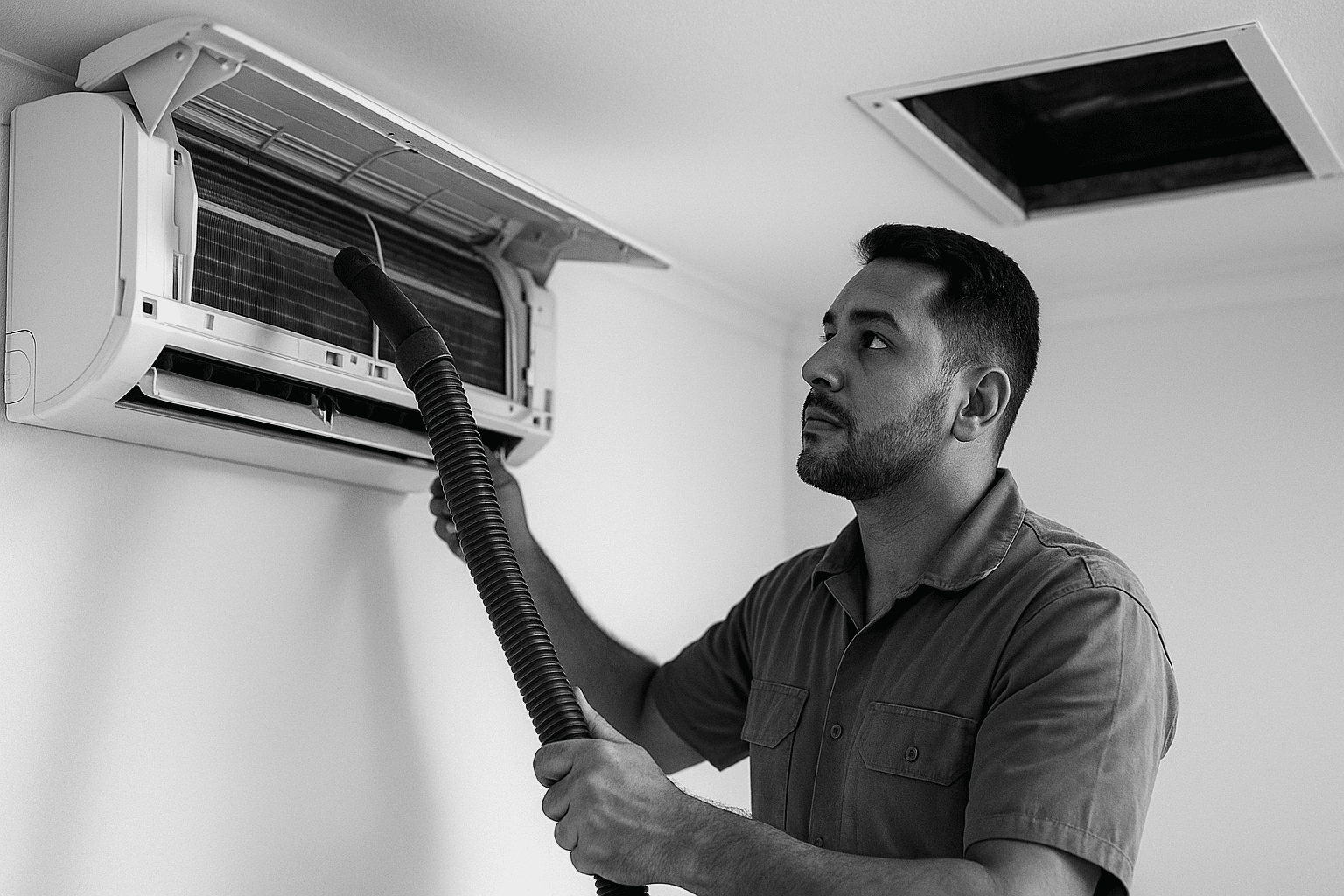
A qualified technician will use inspection cameras or access panels to visually assess internal duct surfaces, coil condition, drain pan status, and insulation integrity. In NADCA-aligned inspections, the assessment is documented with photographic evidence before any cleaning begins. This documentation serves as the baseline for measuring the improvement achieved after service. Understanding Mold Inside AC Ducts: What Dubai Residents Should Know helps with this aspect.
Coil and Drain Component Evaluation
The evaporator coil and drain pan must be assessed as part of any credible contamination investigation. Saniservice specialists, working to triple ISO-certified and NADCA-accredited standards, treat coil inspection as a non-negotiable step — because a clean duct system connected to a contaminated coil will recontaminate within weeks. This cycle is one of the most common patterns observed in Dubai homes where repeated cleaning visits have failed to resolve persistent odours. Mold Inside AC Ducts: What Dubai Residents Should Know factors into this consideration.
Indoor Air Quality Testing
In cases where occupant health concerns are present — particularly in homes with children, elderly residents, or those with known respiratory sensitivities — air quality testing using calibrated sampling equipment provides measurable data. Saniservice operates its own microbiology laboratory, which means test results are processed and interpreted in-house rather than through a generic third-party service. This gives Dubai residents a verifiable before-and-after picture of their indoor environment. This relates directly to Mold Inside AC Ducts: What Dubai Residents Should Know.
Mold Inside AC Ducts — Professional Cleaning Methods That Work
Not all AC cleaning approaches are equally effective against established duct contamination. Dubai residents evaluating service providers should understand the difference between surface-level cleaning and full-system remediation. When considering Mold Inside AC Ducts: What Dubai Residents Should Know, this becomes clear.
HEPA-Filtered Negative Pressure Containment
Professional duct cleaning to NADCA standards uses negative pressure equipment fitted with HEPA filtration. This creates a controlled airflow direction that draws dislodged contamination toward the collection unit rather than distributing it through the occupied space. In Dubai villas and apartments where families are present during the day, this containment approach is not optional — it is the standard that separates professional remediation from basic servicing. The importance of Mold Inside AC Ducts: What Dubai Residents Should Know is evident here.
Coil Cleaning and Biofilm Removal
Effective mold remediation inside AC ducts requires coil cleaning as an integrated step. Removing the biofilm layer from evaporator coil fins using appropriate pH-balanced chemical agents — applied at concentrations validated for occupied residential environments — addresses the contamination source rather than its downstream effects. Without this step, duct cleaning alone provides only temporary improvement. Understanding Mold Inside AC Ducts: What Dubai Residents Should Know helps with this aspect.
Antibacterial and Antifungal Disinfection
Following mechanical cleaning, surface disinfection using approved antimicrobial agents is applied to internal duct surfaces, coil housing, and drain components. Saniservice uses human-safe chemistry validated for use in occupied environments, including homes with infants and sensitive occupants. Adequate ventilation after treatment is always confirmed before the system is returned to normal operation. Mold Inside AC Ducts: What Dubai Residents Should Know factors into this consideration.
Prevention — How Dubai Residents Can Reduce Recurrence
Mold inside AC ducts is more effectively managed through prevention than repeated remediation. Several practical measures significantly reduce recurrence intervals in Dubai’s climate. This relates directly to Mold Inside AC Ducts: What Dubai Residents Should Know.
- Schedule professional full-system cleaning at least once per year, ideally before the peak humidity months of June to September.
- Replace or clean filters on the schedule specified for your system — clogged filters increase internal moisture retention and reduce airflow balance.
- Ensure all duct joints and register connections are properly sealed to minimise warm air infiltration.
- Request drain pan and drain line flushing as part of any AC service visit, not as an optional add-on.
- Consider an annual indoor air quality test as a baseline measurement — particularly in homes with children or occupants with respiratory sensitivities.
- In Dubai villas with large duct networks, post-construction cleaning after any renovation work is essential, as construction dust accelerates biological growth cycles significantly.
When to Request Professional Help for Mold Inside AC Ducts
Dubai residents do not need to wait for visible mold growth to request a professional inspection. In fact, waiting for visible evidence means the contamination has already progressed well beyond its earliest and most easily addressed stage.
A persistent musty odour that has not resolved after filter cleaning is sufficient reason to request a full-system assessment. The same applies to any situation where the same rooms consistently feel less comfortable than others despite similar thermostat settings, or where occupants report morning congestion that improves after leaving the building.
Mold inside AC ducts is a condition that responds well to professional intervention when that intervention addresses the complete system — coils, drain components, ductwork, and registers — rather than individual components in isolation. A service that leaves the coil untreated or skips the drain pan has not resolved the contamination; it has rearranged it.
Expert Takeaways for Dubai Villa and Apartment Residents
After more than 13 years working inside Dubai’s HVAC systems, these are the consistent findings that matter most for residents evaluating their own situation:
- Odour is a more reliable early indicator than visible surface marks — trust your senses and investigate early.
- Coil condition determines how long any duct cleaning result will hold — always confirm this is included in any service.
- Drain pan and drain line health is the most frequently neglected component in standard AC service visits across the UAE.
- Post-construction contamination in Dubai villas is particularly severe — renovation dust creates accelerated biological growth cycles that require dedicated deep-cleaning protocols.
- Annual servicing aligned with NADCA methodology, performed by ISO-certified specialists, delivers measurable improvement that holds between service intervals — rather than requiring repeat visits every few months.
- Mold inside AC ducts is addressable. The outcome, when the job is done properly, is an air environment that feels different — quieter, cleaner, more comfortable to breathe in every room.
Frequently Asked Questions
How do I know if there is mold inside my AC ducts in Dubai?
The most reliable early indicator is a musty or earthy odour that appears when the AC operates and reduces when windows are opened. Dark residue around supply registers, rooms that feel consistently stuffier than others, and air quality that seems heavier in the mornings are all commonly observed patterns during professional assessments of Dubai residential systems. A formal inspection with internal camera access provides definitive confirmation.
Is mold inside AC ducts common in Dubai apartments and villas?
It is among the most frequently identified findings during professional HVAC inspections across Dubai’s residential sector. The combination of continuous system operation, seasonal humidity, sealed indoor environments, and desert dust infiltration creates conditions that are more conducive to biological growth than those found in most other climates. Field investigations across Dubai villas, apartments, and commercial buildings consistently confirm this as a recurring pattern.
What causes mold to grow inside AC ducts specifically?
Mold inside AC ducts develops when moisture, organic particulate matter, and surfaces at the right temperature converge. In Dubai systems, the evaporator coil and condensate drain pan are the primary origin points. Biofilm builds on coil surfaces, moisture accumulates in drain components, and dust provides the organic substrate. Air circulating through the system then distributes this contamination progressively through the duct network.
How often should AC ducts be professionally cleaned in Dubai to prevent mold?
Based on field experience across Dubai’s residential sector, a minimum annual full-system cleaning — covering coils, drain components, and ductwork — is the standard recommended interval for homes in continuous use. Properties with post-construction contamination, high occupant sensitivity, or previous odour issues may benefit from more frequent assessment. The key is that each service addresses the complete system rather than surface components only.
Can standard filter replacement fix mold inside AC ducts in Dubai?
Filter replacement addresses the air filtration stage of the system but does not remediate contamination already present on coil surfaces, duct walls, or drain components. In many Dubai homes where mold inside AC ducts has already developed, filter replacement produces no meaningful change in odour or air quality because the contamination source remains untreated upstream of the filter. Professional full-system cleaning is required to address established duct contamination.
What should I expect from a professional mold remediation service for AC ducts in Dubai?
A credible service will include internal inspection with documentation, HEPA-filtered negative pressure cleaning of ductwork, coil biofilm removal, drain pan and drain line cleaning, and antimicrobial disinfection applied to internal surfaces. Saniservice specialists follow NADCA-aligned methodology with triple ISO certification, and services performed in occupied Dubai homes use chemistry validated as safe for residential environments including those with children and elderly occupants.
Is mold inside AC ducts a problem in Abu Dhabi and Sharjah homes as well?
Yes. The conditions that drive mold inside AC ducts in Dubai — continuous system operation, high summer humidity, desert dust infiltration, and sealed building envelopes — are consistent across the UAE including Abu Dhabi, Sharjah, Ajman, and Ras Al Khaimah. Humidity levels and dust profiles vary slightly by location, but the fundamental contamination mechanisms are the same, and the same professional cleaning standards apply across all Emirates.
Here Is What Happens When the Air Changes
There is a moment, usually the morning after a full-system clean, when you walk into a room that runs off a properly serviced system and something is different. The air feels lighter. The room seems more comfortable at the same thermostat setting. The smell that you had almost normalised is simply gone. That change is measurable — in coil condition, in drain pan cleanliness, in duct surface readings — but you feel it before you see the data.
Mold inside AC ducts is a condition that Dubai residents should know about not because it is alarming, but because understanding it puts you in a position to act early, ask the right questions, and choose a service that addresses root causes rather than symptoms. The standard exists. The methodology exists. What changes is knowing to ask for it.
If you have noticed any of the indicators described in this article — a persistent odour, rooms that feel heavier than they should, or a recurring residue around your registers — a professional indoor air quality assessment is the natural next step. See what your air quality actually looks like, and make the decision from there. Understanding Mold Inside AC Ducts: What Dubai Residents Should Know is key to success in this area.