AC Maintenance Guide for Developers: Boost System Longevity
Managing a luxury property in Dubai means dealing with relentless heat and humidity that can quickly wear down even the best air conditioning systems. Overlooking advanced maintenance invites inefficiency, comfort issues, and declining indoor air quality that residents will notice fast. By focusing on a thorough assessment, planned care, and evidence-based cleaning and disinfection practices, you protect your investment and create a healthier living environment for every occupant. For property managers and villa owners, structured maintenance programs are the foundation for reliable AC performance in the unique Dubai climate.
Table of Contents
Contents
- 1 Table of Contents
- 2 Quick Summary
- 3 Step 1: Assess Current AC System and Plan Maintenance
- 4 Step 2: Inspect and Clean Essential AC Components
- 5 Step 3: Disinfect System Using Evidence-Based Methods
- 6 Step 4: Verify Performance and Indoor Air Quality
- 7 Ensure Your AC System’s Longevity with Expert Care from Saniservice
- 8 Frequently Asked Questions
- 8.0.1 How often should I assess my AC system for maintenance?
- 8.0.2 What key components should I inspect during AC maintenance?
- 8.0.3 How can I verify my AC system’s performance after maintenance?
- 8.0.4 What disinfection methods are recommended for AC systems?
- 8.0.5 Why is documenting my AC maintenance important?
- 9 Recommended
- Step 1: Assess Current AC System and Plan Maintenance
- Step 2: Inspect and Clean Essential AC Components
- Step 3: Disinfect System Using Evidence-Based Methods
- Step 4: Verify Performance and Indoor Air Quality
Quick Summary
| Key Message | Explanation |
|---|---|
| 1. Assess Your AC System | Document specifications and performance to identify issues early and inform your maintenance plan effectively. |
| 2. Maintain Essential Components | Regularly clean and inspect filters, coils, and drainage systems to improve efficiency and indoor air quality. |
| 3. Implement Disinfection Protocols | Use proven disinfection methods to eliminate harmful microorganisms after thorough cleaning of your AC system. |
| 4. Verify Performance Regularly | Measure cooling performance and indoor air quality against established standards to ensure system efficiency and health. |
| 5. Document All Maintenance Actions | Keep detailed records of inspections and actions taken to protect warranties and enhance future service effectiveness. |
Step 1: Assess Current AC System and Plan Maintenance
Before you can maintain your AC system effectively, you need to understand what you’re working with. Assessing your current system establishes a baseline for performance and identifies potential issues before they become costly problems. This foundational step shapes every maintenance decision you’ll make moving forward.
Start by documenting your AC system’s specifications. Record the unit’s age, model number, cooling capacity (measured in BTUs), installation date, and any previous repair history. Check your equipment documentation or contact the original installer if records are missing.
Next, observe how your system performs under different conditions. Note whether cooling is consistent across all rooms, how quickly the system reaches your desired temperature, and whether you notice any unusual sounds or odors. These observations reveal real-world operating patterns that will inform your maintenance plan.
Conduct a visual inspection of key components:
- Condenser unit outside your villa or building for visible damage, debris, or corrosion
- Indoor air handler and ductwork for signs of leaks, dust accumulation, or visible mold
- Drainage trays and condensate lines for standing water or blockages
- Filters to assess dirt buildup and current filtration status
Maintenance task analysis involves identifying the specific tools, technician skills, and facility requirements needed to maintain your system efficiently. In Dubai’s heat and humidity, your AC undergoes significant stress, making this analysis especially valuable for luxury properties.
Create a baseline maintenance plan based on your findings. Structured maintenance programs establish maintenance intervals and resource requirements to keep systems operating at peak performance and reliability. For property managers overseeing multiple units, documenting this information ensures consistency and prevents maintenance gaps.
Determine your maintenance frequency by considering your system’s age, usage intensity, and local environmental factors. Newer units in moderate use may need quarterly inspections, while older systems in continuous operation should be checked monthly.
Identify any immediate concerns requiring professional attention. Visible leaks, strange noises, or significantly reduced cooling capacity warrant professional evaluation before implementing your regular maintenance schedule.
Your baseline assessment becomes the reference point for all future maintenance decisions and helps you catch performance decline early.
Pro tip: Create a digital maintenance log using your smartphone or property management software, noting inspection dates, findings, and actions taken—this record protects your warranty coverage and helps SaniAC by Saniservice technicians provide targeted service when needed.
Here’s a comparison of common AC maintenance tasks and their impact on system health:
| Task | Frequency in Dubai | Impact on AC System |
|---|---|---|
| Filter replacement | Monthly to 90 days | Improves air quality, efficiency |
| Coil cleaning | 6-12 months | Prevents heat transfer loss |
| Drain flushing | Every 3-6 months | Avoids water leaks, mold risk |
| Duct inspection | Annually | Reduces leaks, contamination |
| Electrical check | Annually | Prevents failures, fire hazards |
Step 2: Inspect and Clean Essential AC Components
Now that you understand your system’s baseline condition, it’s time to perform hands-on inspection and cleaning of the critical components that directly impact performance and air quality. This step removes accumulated debris and contamination that restricts airflow and reduces cooling efficiency.
Start with your air filters, which are the first line of defense against dust and particles. Check them monthly and replace them every 30 to 90 days depending on usage and air quality in your Dubai property. A clogged filter forces your compressor to work harder, increasing energy consumption and shortening system life.
Next, inspect your evaporator and condenser coils. These aluminum fins transfer heat during the cooling process, but they collect dust, pollen, and microbial growth over time. Regular coil cleaning procedures remove debris that impairs heat transfer and system efficiency.
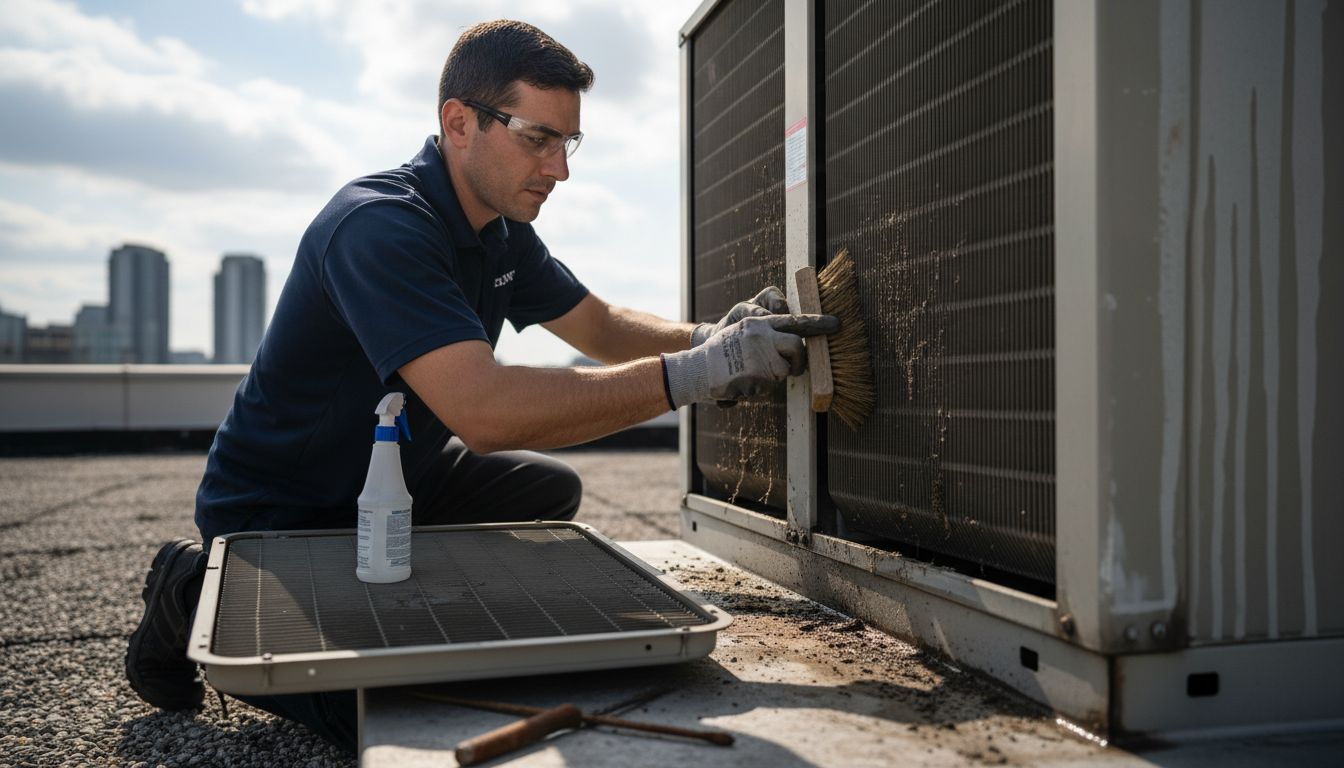
Examine your drainage system carefully. The condensate drain pan and drain line collect water continuously in Dubai’s humid climate. Standing water creates ideal conditions for mold and bacterial growth, which can spread throughout your system and into indoor air. Flush drain lines with appropriate cleaning solutions to prevent blockages.
Inspect these components systematically:
- Blower fans for dust accumulation and proper rotation
- Ductwork for visible leaks, disconnections, or insulation damage
- Electrical connections for corrosion or loose terminals
- Refrigerant lines for visible leaks, ice buildup, or damage
- Compressor for unusual vibration or noise patterns
For luxury villas and multi-unit buildings in Dubai, professional deep cleaning goes beyond standard maintenance. SaniAC by Saniservice uses specialized disinfection procedures that eliminate biofilm, mold spores, and bacterial colonies that conventional cleaning misses.
Document your findings with photos or notes. Compare your observations to your baseline assessment from Step 1. Any significant changes warrant immediate professional evaluation.
Clean components operate efficiently, consume less energy, and deliver healthier indoor air for your residents or tenants.
Pro tip: Schedule your most intensive cleaning during cooler months like December or January when AC demand drops, allowing your system downtime for thorough deep cleaning without impacting occupant comfort.
Step 3: Disinfect System Using Evidence-Based Methods
Cleaning removes visible debris, but disinfection eliminates the microorganisms that compromise air quality and occupant health. This step requires using proven disinfection protocols that target bacteria, mold, viruses, and other pathogens living in your AC system.
Understand the difference between cleaning and disinfection. Cleaning removes organic material like dust and biofilm buildup that can actually shield microorganisms from disinfectants. Effective disinfection relies on proper concentrations and contact times to eliminate pathogens after cleaning surfaces thoroughly.
Select appropriate disinfectants based on your system components and target microorganisms. Common EPA-registered options include hydrogen peroxide solutions for coils and drain pans, quaternary ammonium compounds for ductwork, and hospital-grade biosanitizers for comprehensive system treatment.
Follow this systematic disinfection approach:
- Clean all surfaces first to remove organic material that inhibits disinfectant effectiveness
- Apply disinfectant at manufacturer-recommended concentrations using appropriate application methods
- Allow proper contact time as specified by the disinfectant product label
- Ensure adequate ventilation during and after application to prevent chemical accumulation
- Verify material compatibility to avoid damaging aluminum coils or sensitive components
In Dubai’s warm, humid climate, microbial growth happens rapidly. Chemical disinfectants selected for specific microorganisms provide targeted protection against the bacteria and mold species common in the UAE’s environment.
For comprehensive protection, many property managers in Dubai rely on professional disinfection services like SaniAC by Saniservice. Our NADCA-certified technicians use hospital-grade biosanitizers that eliminate biofilm colonies chemical-free, protecting both system components and indoor air quality for residents.
Document your disinfection process with dates, products used, concentrations, and contact times. This record demonstrates compliance with health standards and helps track the effectiveness of your maintenance program.
Disinfection transforms your AC system from a potential microbial reservoir into a safeguard for healthy indoor air throughout your property.
Pro tip: Combine chemical disinfection with UV-C light treatment in your air handling unit for enhanced microbial control; the two methods work synergistically to eliminate pathogens that chemical-only approaches might miss.
Step 4: Verify Performance and Indoor Air Quality
After completing maintenance and disinfection, verification confirms that your AC system delivers both optimal cooling performance and healthy indoor air. This step involves measuring key parameters against established standards to ensure your system meets occupant health and efficiency requirements.
Begin by checking cooling performance metrics. Measure temperature differentials between return and supply air, verify that your system reaches set temperatures within expected timeframes, and confirm that cooling is uniform across all rooms. Compare these measurements to your baseline assessment from Step 1 to identify any performance changes.
Next, assess indoor air quality through tangible indicators. Check for visible dust accumulation on surfaces, notice any musty odors suggesting microbial growth, and observe occupant comfort levels. ASHRAE ventilation standards specify minimum air exchange rates and filtration requirements that your system should meet to protect occupant health.
Measure these critical indoor air quality factors:
- Particulate matter levels using portable air quality monitors
- Relative humidity to ensure it stays between 30 and 50 percent
- Carbon dioxide concentrations indicating adequate ventilation
- Airflow rates at vents and grilles to verify system balance
- Temperature consistency throughout conditioned spaces
For property managers in Dubai, EPA air quality guidelines provide benchmarks for acceptable indoor air conditions. Professional testing services can measure volatile organic compounds, microbial contaminants, and other parameters that standard equipment cannot detect.
Document all verification measurements and compare results to pre-maintenance baselines. Significant improvements in temperature stability, reduced humidity fluctuations, and better air quality distribution indicate successful maintenance.
Schedule verification testing at least quarterly for luxury properties and annually for standard residential units. Regular monitoring catches performance degradation early before problems impact occupants.
Verified performance metrics transform maintenance from routine activity into measurable proof that your system protects both equipment longevity and occupant health.
Pro tip: Invest in continuous air quality monitoring devices that track particulate matter and humidity in real time, allowing you to correlate AC maintenance activities with immediate improvements in indoor air quality for your residents.
Here’s a summary of recommended air quality metrics and their optimal ranges:
| Metric | Optimal Range | Significance |
|---|---|---|
| Relative humidity | 30-50% | Prevents mold, maintains comfort |
| Particulate matter | < 35 µg/m³ | Ensures clean air, less dust |
| CO₂ concentration | < 1000 ppm | Indicates adequate ventilation |
| Temperature variance | < 2°F room-to-room | Promotes comfort, energy savings |
Ensure Your AC System’s Longevity with Expert Care from Saniservice
The AC Maintenance Guide for Developers highlights the critical importance of regular assessment, cleaning, disinfection, and performance verification to boost system lifespan and maintain healthy indoor air quality. If you are facing challenges such as clogged filters, microbial growth, decreased cooling efficiency, or overwhelming maintenance details, you are not alone. These pain points can lead to high energy costs, equipment failure, and compromised comfort. Saniservice offers a science-driven solution that addresses these exact concerns by delivering precision cleaning and hospital-grade disinfection tailored to Dubai’s demanding climate.
Take control of your AC system durability today with Saniservice’s professional air conditioning cleaning and disinfection that combines Swiss-quality methods and NADCA-certified expertise. Our multidisciplinary team ensures your components are meticulously maintained to prevent microbial buildup, improve energy efficiency, and safeguard occupant health. Don’t wait for costly repairs or poor air quality to impact your investment. Visit Saniservice now and transform your AC maintenance program into a proven system longevity solution.
Frequently Asked Questions
How often should I assess my AC system for maintenance?
To maintain optimal performance, assess your AC system at least once every six months. Document your findings and develop a baseline maintenance plan to ensure you catch potential issues early.
What key components should I inspect during AC maintenance?
During maintenance, inspect air filters, evaporator and condenser coils, drainage systems, and blower fans. Regularly clean these components to improve efficiency and indoor air quality.
How can I verify my AC system’s performance after maintenance?
Verify your AC system’s performance by measuring temperature differentials and checking indoor air quality metrics, such as humidity and particulate matter levels. Conduct these verifications quarterly to ensure consistent performance and comfort within your property.
What disinfection methods are recommended for AC systems?
Use EPA-registered disinfectants appropriate for your system components to eliminate harmful microorganisms. Follow the manufacturer’s guidelines for application and contact times to ensure effective disinfection.
Why is documenting my AC maintenance important?
Documenting your AC maintenance ensures you have a reliable record for warranty protection and compliance with health standards. Include dates, tasks performed, and findings to provide a comprehensive history for future reference.
Recommended
- AC Maintenance Guide 2025: Ensure Clean, Healthy Airflow – Saniservice AC Cleaning
- AC Maintenance Step by Step Guide for Cleaner Indoor Air
- Why Maintain AC Systems – The Health & Cost Impact
- Why AC Maintenance Saves Energy: 7 Powerful Reasons Every Home Should Know
- Blog – FullyOps
- Understanding Long-Term Carpet Maintenance for Your Home – Yarra Valley Carpet Cleaning
- Heating System Maintenance Tips For Sacramento Area Homeowners 2025 – Legacy Plumbing & Drain – Emergency Plumbers Of Sacramento