How Dubai Humidity Affects AC Duct Contamination Guide
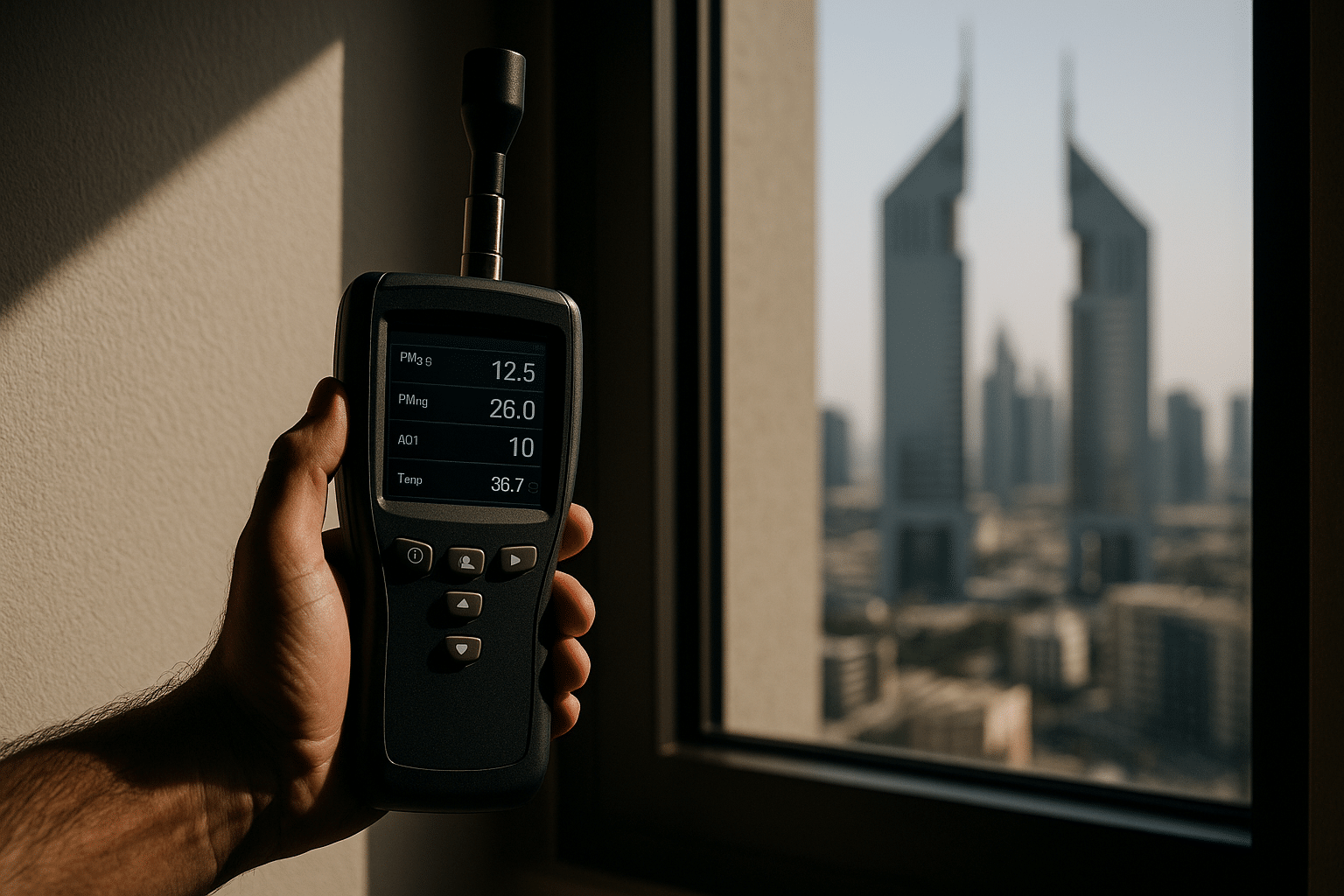
In Dubai’s climate, How Dubai Humidity affects AC duct contamination is shaped by a continuous cycle of moisture, dust infiltration, and sealed indoor environments that recirculate air rather than dilute it. Ductwork that looks clean from the outside can accumulate layers of particulate matter, biofilm, and microbial growth along internal surfaces — particularly during the summer months when outdoor humidity regularly exceeds 80%. Understanding this cycle is the first step towards cleaner, more comfortable air inside your home.
Dubai residents spend a significant portion of their daily lives indoors with air conditioning running continuously. Unlike temperate climates where systems switch off overnight and allow surfaces to dry, UAE residential systems often operate around the clock. This means duct interiors remain at elevated moisture levels for extended periods, which creates conditions that favour the gradual accumulation of biological material. The impact is rarely dramatic — it builds slowly, which is precisely why it goes unnoticed for so long. This relates directly to How Dubai Humidity Affects AC Duct Contamination.
This article draws on field observations from over a decade of residential HVAC assessment across Dubai, Sharjah, Abu Dhabi, and the broader UAE to explain the mechanisms behind moisture-driven duct contamination, what Saniservice specialists identify during professional inspections, and why addressing root causes matters more than surface cleaning.
How Dubai Humidity Affects AC Duct Contamination – The Moisture Cycle Inside Dubai AC Ductwork
How Dubai humidity affects AC duct contamination begins at the evaporator coil. When warm, humid air from inside your home passes over a cold coil, moisture condenses on the coil surface. This is normal and expected. What matters is what happens to that moisture — and what it carries — as it moves through the rest of the system.
In properly functioning systems, condensate drains away through the drain pan and drain line. However, any disruption to this process — a partially blocked drain, a coil coated in biofilm, or insufficient airflow — causes moisture to linger. That lingering moisture becomes the foundation for the contamination cycle that Saniservice specialists commonly observe during duct inspections across Dubai villas and apartments. When considering How Dubai Humidity Affects AC Duct Contamination, this becomes clear.
Why Dubai Summer Months Intensify the Problem
Between June and September, outdoor dew points in Dubai can reach levels where even small temperature differentials cause condensation on duct surfaces. In poorly insulated ductwork — or in sections where insulation has degraded — the outer duct surface becomes cold relative to the surrounding plenum space. This draws moisture inward, creating secondary condensation points well beyond the coil itself.
Flexible ductwork, commonly used in Dubai apartment buildings, is particularly vulnerable during these months. The accordion-like interior surface of flexible ducts creates low points where moisture can collect. Combined with the fine mineral dust carried in from desert and construction environments, these pockets create exactly the substrate that supports biological accumulation over time. The importance of How Dubai Humidity Affects AC Duct Contamination is evident here.
How Dubai Humidity Affects AC Duct Contamination Through Dust and Biofilm Interaction
Dust in Dubai’s outdoor environment carries a particular composition that differs from European or North American construction dust. Fine silica particles, gypsum from construction activity, and organic material from the broader desert environment all pass through AC filters — especially when filters are overdue for replacement or when filter bypass occurs around poorly fitted frames.
When this dust settles on moist duct surfaces, it forms a matrix that is significantly more adhesive than dry dust alone. Laboratory analysis conducted through Saniservice’s in-house microbiology facility has confirmed that this dust-moisture matrix is a common precursor to biofilm formation in Dubai residential ductwork. Biofilm — a structured community of microorganisms encased in a self-produced matrix — is considerably more resistant to removal than loose particulate accumulation. Understanding How Dubai Humidity Affects AC Duct Contamination helps with this aspect.
The Role of Continuous AC Operation in Biofilm Development
In a climate where AC systems rarely pause, biofilm communities inside ductwork have no natural drying cycle to interrupt their development. This is fundamentally different from seasonal climates. A system that runs continuously for eight to ten months without a deep clean provides stable, moist, nutrient-rich surfaces that support biofilm maturation. What begins as a thin microbial film gradually thickens and becomes more structurally complex.
Saniservice field investigations across Dubai villas in areas including Jumeirah, Arabian Ranches, and the Palm regularly identify established biofilm layers on evaporator coils and in the first sections of supply ductwork nearest the air-handling unit. These are the areas where condensate is most active and where contamination typically originates before spreading downstream. How Dubai Humidity Affects AC Duct Contamination factors into this consideration.
Condensate Drain Pan Conditions and Their Effect on Duct Air Quality
How Dubai humidity affects AC duct contamination is directly connected to the condition of the condensate drain pan. The drain pan sits beneath the evaporator coil and collects the moisture that drips from the coil surface during normal operation. In humid climates, drain pans handle a substantial volume of water daily — and any stagnation within that pan becomes a contamination source that affects the air passing over it.
Saniservice specialists frequently identify biofilm accumulation in drain pans during residential assessments across Dubai apartments and villas. This biofilm releases volatile compounds as air moves across the pan surface, which is commonly the source of the sour or musty odour that many residents notice shortly after their AC starts — particularly in the morning when the system ramps up after a period of lower airflow overnight. This relates directly to How Dubai Humidity Affects AC Duct Contamination.
Why Drain Line Blockages Amplify Contamination Risk
Partially blocked drain lines cause water to pool in the drain pan rather than flow out continuously. Stagnant water combined with the warm environment inside the air-handling unit creates accelerated biological activity. This pooling also increases humidity levels within the unit cabinet itself, which then passes into the duct system with every cycle of airflow. Addressing the drain line is therefore not a peripheral task — it is central to breaking the contamination cycle.
How Dubai Humidity Affects AC Duct Contamination in Villas Versus Apartments
The contamination profile of a standalone Dubai villa differs meaningfully from that of a high-rise apartment, and both differ from commercial spaces. Villa systems typically use galvanised iron (GI) ductwork running through ceiling voids, often adjacent to roof spaces that experience significant thermal variation. This creates larger temperature differentials across duct surfaces and increases the likelihood of condensation on uninsulated or degraded duct sections. When considering How Dubai Humidity Affects AC Duct Contamination, this becomes clear.
Apartment systems more commonly use pre-insulated ductwork or flexible duct runs from fan coil units. These systems have shorter duct runs but are more susceptible to moisture ingress at duct joints and connections. The proximity of multiple units sharing riser spaces also means that contamination patterns can be influenced by neighbouring units — a factor that Saniservice specialists account for during assessments in buildings across Dubai Marina, JLT, and Downtown Dubai.
Post-Renovation Duct Contamination and Humidity Interaction
Renovation work produces fine construction dust that enters ductwork through open registers, damaged duct sections, or during periods when AC systems are operated before construction dust has fully settled. In Dubai’s humid environment, this construction dust — carrying gypsum, adhesive compounds, and fine particulate matter — adheres readily to moist duct surfaces. The combination of renovation residue and moisture creates a particularly dense contamination layer that requires mechanical extraction under negative pressure to address properly. The importance of How Dubai Humidity Affects AC Duct Contamination is evident here.
Recognising the Signs That Humidity Has Affected Your Duct System
Understanding how Dubai humidity affects AC duct contamination helps residents recognise the signals before they become significant. The following indicators are commonly reported by clients prior to Saniservice assessments across Dubai residential properties.
- A musty or sour smell that appears shortly after the AC starts, particularly in the morning
- Reduced airflow from one or more supply diffusers despite the system running normally
- Visible discolouration around supply diffuser grilles, particularly dark or greyish rings
- Condensation visible on supply diffusers or the immediate ceiling area around them
- Family members reporting increased nasal sensitivity or morning congestion without an obvious external cause
- A persistent odour that returns within days of having the system surface-cleaned
None of these signs requires alarm — but each one indicates that the system warrants professional inspection to determine where in the HVAC pathway the contamination is most concentrated. Understanding How Dubai Humidity Affects AC Duct Contamination helps with this aspect.
Why Surface Cleaning Alone Does Not Address Humidity-Driven Contamination
How Dubai humidity affects AC duct contamination reveals why cosmetic or surface-level cleaning approaches fall short. Wiping diffuser grilles or spraying a disinfectant into the supply registers addresses only the outermost layer of a contamination profile that extends back through metres of ductwork to the coil surface and drain pan. If the source conditions — biofilm on the coil, moisture in the drain pan, degraded duct insulation — remain unchanged, the visible symptoms return within weeks.
NADCA-aligned duct cleaning methodology addresses this by combining mechanical agitation to dislodge accumulated material, HEPA-filtered negative pressure containment to capture dislodged particulate without releasing it into the living space, and targeted antimicrobial treatment on coil surfaces and drain components. Saniservice applies this methodology across Dubai residential properties using equipment and chemistry appropriate for occupied homes, including where children and allergy-sensitive occupants are present. How Dubai Humidity Affects AC Duct Contamination factors into this consideration.
How Often Dubai Residents Should Address Duct Contamination
Given how Dubai humidity affects AC duct contamination on a year-round basis, the appropriate cleaning frequency differs from international recommendations designed for seasonal climates. Saniservice field experience across the UAE indicates that residential systems in Dubai benefit from professional duct and coil assessment on an annual basis, with drain pan and drain line checks conducted at least twice yearly — ideally before and after the summer peak humidity period.
Properties with specific factors — recent renovation, older ductwork, residents with respiratory sensitivities, or systems that have not been professionally serviced in more than two years — may benefit from an initial assessment to establish the current contamination baseline before scheduling ongoing maintenance intervals. Professional assessment determines scope; a property-specific quote reflects the size of the system, duct type, and access conditions. This relates directly to How Dubai Humidity Affects AC Duct Contamination.
Expert Takeaways for Dubai Residents
- Replace AC filters on the schedule recommended for your system — filter bypass around a clogged filter accelerates duct contamination
- If you notice a musty smell on startup, prioritise a drain pan and coil inspection rather than a repeat surface clean
- After any renovation work, arrange professional duct cleaning before extended AC operation resumes — construction dust adheres rapidly to moist duct surfaces in Dubai’s climate
- Ask any AC cleaning provider whether their methodology includes negative pressure containment — this determines whether dislodged material is removed or redistributed
- Consider the condition of your duct insulation — degraded insulation increases condensation on duct surfaces and accelerates the contamination cycle
- Establish a documented cleaning history for your AC system — this is useful for property management reporting and for tracking the interval at which contamination typically returns in your specific property
Frequently Asked Questions
How does Dubai humidity affect AC duct contamination differently than in cooler climates?
In cooler climates, AC systems operate seasonally, giving duct surfaces time to dry out and interrupting biological growth cycles. In Dubai, systems run continuously for most of the year, maintaining moist duct surfaces without interruption. This sustained moisture environment, combined with fine desert and construction dust, creates conditions that accelerate biofilm development at a rate not seen in temperate climates.
What causes the musty smell from AC vents in Dubai homes?
The musty or sour odour commonly reported by Dubai residents is most frequently associated with biofilm accumulation on evaporator coils or in condensate drain pans. As air moves over these surfaces during system operation, volatile compounds from biological material are carried into the living space. Surface cleaning of diffuser grilles does not address this source — coil and drain pan treatment is required to resolve it durably. When considering How Dubai Humidity Affects AC Duct Contamination, this becomes clear.
Can humidity cause visible discolouration around AC vents?
Yes. Dark or grey discolouration around supply diffusers in Dubai apartments and villas is commonly observed during Saniservice assessments. This discolouration typically reflects a combination of fine particulate matter carried in airflow and the adhesive quality of moist duct surfaces near the diffuser. It is a reliable surface indicator that contamination within the duct system warrants professional inspection.
How often should Dubai villa owners schedule professional duct cleaning?
Based on field experience across Dubai residential properties, annual professional duct and coil cleaning is appropriate for most villas under normal occupancy conditions. Properties that have undergone renovation, have not been professionally serviced in more than two years, or house occupants with respiratory sensitivities may benefit from an initial assessment to determine the appropriate interval for their specific system and usage profile. The importance of How Dubai Humidity Affects AC Duct Contamination is evident here.
Significantly so. Construction dust produced during renovation work contains gypsum, adhesive compounds, and fine particulate matter that adheres readily to the moist internal surfaces found in Dubai ductwork. When an AC system is operated before this dust has been professionally removed from the duct system, it compacts onto coil and duct surfaces and becomes considerably more difficult to address than standard operational accumulation.
Flexible ductwork presents specific vulnerability due to its accordion-like internal surface, which creates low points where moisture and particulate matter collect. In Dubai apartments — particularly those in high-humidity coastal areas such as Dubai Marina, JBR, and the Palm — flexible duct sections nearest the fan coil unit warrant priority inspection during professional assessments, as these sections accumulate contamination most rapidly.
A standard AC service typically covers filter replacement, coil surface wiping, and refrigerant checks. Professional duct cleaning aligned with NADCA methodology involves mechanical agitation of duct interiors, HEPA-filtered negative pressure extraction to remove dislodged material, and antimicrobial treatment of coil surfaces and drain components. The distinction matters because humidity-driven contamination in Dubai ductwork extends well beyond what a standard service reaches.
Clean Air Begins at the Source
How Dubai humidity affects AC duct contamination is not a problem that resolves itself or responds to surface-level attention. The moisture cycle is continuous, the dust environment is persistent, and the systems that condition Dubai homes run without the seasonal pause that naturally interrupts contamination in other climates. What changes when this cycle is properly addressed is something residents notice immediately — the quality of the air when they walk through the door, the absence of that morning smell, the easier breathing in a bedroom that runs all night.
Saniservice specialists approach every Dubai residential assessment by mapping the contamination pathway from coil to diffuser, identifying where moisture accumulation is most active, and addressing root causes rather than symptoms. That approach — grounded in NADCA methodology, supported by an in-house microbiology laboratory, and delivered by technicians trained for occupied residential environments — is what separates a durable result from a temporary improvement.
If you have noticed any of the indicators described in this guide, a professional assessment of your duct system is the logical next step. Contact Saniservice to see what your air quality looks like. Understanding How Dubai Humidity Affects AC Duct Contamination is key to success in this area.